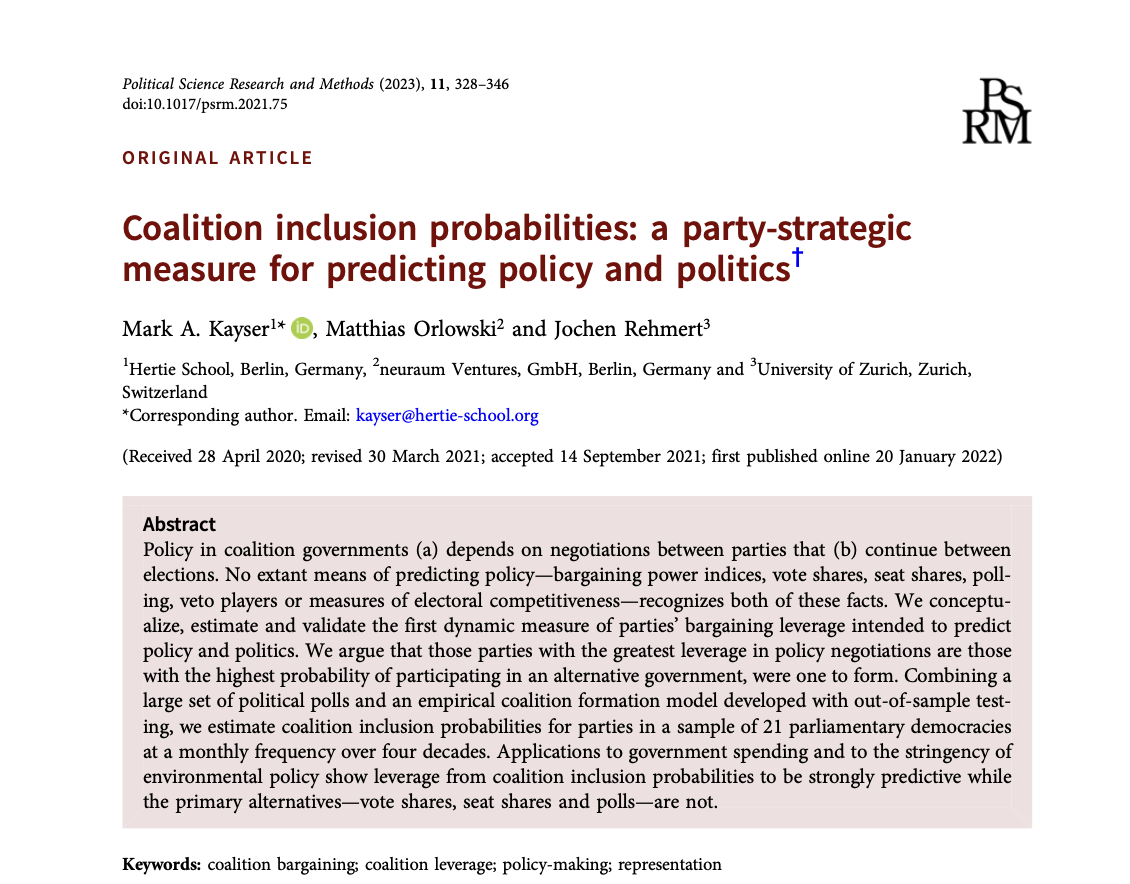
Coalition Inclusion Probabilities: A Party-Strategic Measure for Predicting Policy and Politics

Parties' bargaining leverage — estimated monthly for 21 parliamentary democracies across four decades.

Mark A. Kayser · Jochen Rehmert
Democracies covered
0
Austria · Czech Rep. · Denmark · Estonia · Finland · Germany · Greece · Hungary · Iceland · Ireland · Italy · Netherlands · New Zealand · Norway · Poland · Portugal · Slovakia · Slovenia · Spain · Sweden · Switzerland
Coverage
1970 2024
Update!  Recently extended from 2019 to 2024 — 5 additional years of monthly estimates.
§ 01

Abstract

§ 02

Why Coalition Power Shapes Policy

In most parliamentary democracies, no single party governs alone. Governments are the product of coalition bargaining, and that bargaining continues throughout a government's life. Policy does not emerge cleanly from any party's electoral platform. It is the outcome of ongoing negotiations between partners who are each calculating their outside options at every turn. A party's real leverage in those negotiations comes not from how many seats it holds, but from whether other parties need it to form a viable alternative government. This is what standard measures of vote share, seat share, and polling cannot capture. CIP is the first validated and dynamic measure of this leverage, estimated monthly for every relevant party across 25 OECD democracies since 1970.

01 · The Problem
Polls don't capture bargaining power
A party polling at 20% but excluded by all others has near-zero power. A party polling at 10% that every coalition needs has enormous leverage. Standard measures cannot tell these apart.
02 · The Gap
Prior work was theoretical
Bargaining theorists have long argued that credible exit options shape policy outcomes, but the empirical literature on coalition governments has largely tested parties' resources within the existing government rather than their leverage from outside it. Classical voting power indices capture some of this intuition but rely only on seat shares, omitting the ideological and strategic factors that actually determine which coalitions can form.
03 · What Goes Into the Model
Key variables in the coalition formation model
The model is a conditional logit trained on over 450 historical government formations. It incorporates factors like whether a coalition is the smallest that could hold a majority, whether it replicates the incumbent government, the ideological distance between its most extreme members, and the parties' shared history in government. Anti-establishment parties receive a strong penalty, reflecting how systematically other parties exclude them. Together these predictors capture who is realistically willing to govern with whom, not just who has the most seats.
04 · A Number Between 0 and 1
What CIP Measures
For any party, in any month: "If an election were held today and a new government had to form, what is the probability this party would be part of it?" A CIP of 0.63 means a 63% chance of entering government.
How CIP is Calculated
📱
Step 1
Monthly Polls
Vote intention data aggregated across polling institutes
🏛
Step 2
Seat Simulation
Polls converted to simulated seat share distributions
🤝
Step 3
Coalition Model
Conditional logit model trained on 450+ historical governments
📈
Step 4
CIP Score
Probability (0–1) of each party entering the government if one formed today
👥
Output
Policy Prediction
Spending, environment, pledge fulfillment
Coalition Formation Model Variables
From Table 2, Kayser, Orlowski & Rehmert (2023)
Variable What it captures Effect
Largest party Whether the potential coalition includes the formateur party +
Minimal winning coalition Smallest coalition with majority — maximises portfolio allocation per party +
Status quo Whether this is the incumbent coalition — incumbency advantage is strong ++
Ideological range Distance between most extreme parties in the potential coalition
Anti-establishment party Whether any party in the coalition is shunned as anti-system −−
Third largest party The "kingmaker" — formateur prefers 3rd over 2nd to retain a larger Gamson share +
Cabinet history How often this set of parties has governed together in the past ++
Minority / no-majority Adjusts most predictors based on whether any party holds a majority alone ×
Conditional logit model · 352 formation opportunities · 21 OECD democracies · Out-of-sample AUC = 0.89
§ 03

▫ Interactive Data Explorer

Explore real coalition inclusion probabilities. Select a country and party, then drag the year handles to zoom into any time window. The solid line is CIP (coalition leverage); the dotted line is poll share scaled to 0–1 for comparison.

🌎 Country
◆ Party
🕑 Years
Source: Kayser, Orlowski & Rehmert (2023) · Dynamic CIP Dataset · Gross CIP (excluding=NaN) · Shaded area = 95% confidence interval · Dotted line = poll share scaled to 0–1
§ 04

↕ Data & Replication

Three datasets are available for download. Dynamic and Static folders contain CIP estimates in CSV format, one file per country. The polling dataset contains the raw vote-intention poll data underlying the dynamic CIP estimates.

📊
Dataset 01
Dynamic CIP Data
Monthly coalition inclusion probabilities derived from polling data. Captures how coalition prospects shift between elections as poll numbers change.
Coverage · 21 countries
Period · 1970–2024
Frequency · Monthly
Format · CSV (per country)
↓ Download Dynamic
📄
Dataset 02
Static CIP Data
Election-based coalition inclusion probabilities. Broader country and historical coverage going back to the 1950s.
Coverage · 31 countries
Period · 1953–2024
Frequency · Per election
Format · CSV (per country)
↓ Download Static
📋
Dataset 03
Polling Data
Raw vote-intention polling data underlying the dynamic CIP estimates. Party-level poll results from multiple institutes across all covered countries.
Observations · 327,384 rows
Period · 1970–2025
Columns · 12 variables
Format · Excel (.xlsx)
↓ Download Polls
§ 05

How to Cite

The data are continuously updated, but all uses of the CIP measure and dataset should cite the original published paper.

Kayser, M. A., Orlowski, M., & Rehmert, J. (2023). Coalition inclusion probabilities: A party-strategic measure for predicting policy and politics. Political Science Research and Methods, 11(2), 328–346. https://doi.org/10.1017/psrm.2021.75
§ 06

○ Example Use Cases of CIP

Research applying the CIP measure and dataset across comparative politics, legislative bargaining, and policy representation.
2026
Policy as a Bargaining Outcome: Coalition Leverage and Pledge Fulfillment
Mark A. Kayser, Jochen Rehmert, Petra Schleiter
Forthcoming · British Journal of Political Science
Uses CIP to test whether parties with greater coalition leverage are better able to deliver on their electoral promises. Finds that coalition bargaining leverage consistently outperforms seat share, portfolio share, and classical voting power indices in predicting pledge fulfillment across 9 parliamentary democracies.
2025
Measuring and Understanding Parties' Anti-elite Strategies
Hauke Licht, Tarik Abou-Chadi, Pablo Barberá, Whitney Hua
The Journal of Politics, Vol. 87, No. 1
Applies CIP to study when parties use anti-elite rhetoric on social media. Finds that mainstream parties tone down anti-elite appeals when their coalition inclusion probability is higher.
2021
Coalition Prospects and Policy Change: An Application to the Environment
Mark A. Kayser, Jochen Rehmert
Legislative Studies Quarterly, Vol. 46, No. 1, 219–246
Applies CIP to environmental policy stringency across parliamentary democracies. Shows that Green parties' coalition inclusion probability predicts stricter environmental policy even when the Greens are in opposition — an effect invisible to polls and seat shares.
§ 07

About Us

Two of the three original authors continue to maintain and extend the dataset.

Mark A. Kayser
Hertie School · Berlin, Germany
Professor of Applied Quantitative Methods and Comparative Politics at the Hertie School, Berlin. His research addresses the economic underpinnings of democracy, political accountability, and the institutional sources of governmental representation. He received his PhD from UCLA and has held positions at the University of Rochester, Nuffield College Oxford, and Stanford's Center for Advanced Studies in the Behavioral Sciences.
Jochen Rehmert
University of Basel · Basel, Switzerland
SNSF-Ambizione grant holder at the University of Basel, leading a project on the non-nomination of incumbent politicians. Previously a postdoctoral researcher at the University of Zurich and Humboldt University Berlin. Holds a PhD from the Hertie School in Berlin. Research focuses on candidate selection, coalition formation, legislative politics, and Japanese politics.